
"Be not forgetful of prayer. Every time you pray, if your prayer is sincere, there will be new
feeling and new meaning in it, which will give you fresh courage, and you will understand that
prayer is an education.” (Fyodor Dostoevsky)
The Art of Prayer
Why do we pray? How do we pray? For what, for whom do we pray? These questions and many others arise whenever we face the basic question of what it means for us to pray and why we do so. In this course, we will consider how the Christian spiritual tradition has grappled with these fundamental questions and what we can learn from that tradition about what prayer means for us--contemplative prayer in particular, but also other long-cherished forms of prayer, such as praise, thanksgiving, supplication and intercession. We will consider also what it might mean, as Leo Tolstoy once put it, for one’s whole life to become a prayer. For prayer to be not merely as an occasional or discrete practice, but as an abiding sense of God’s presence that pervades every aspect of one’s existence? The ancient Christian tradition thought of these questions in light of St. Paul’s injunction in I Thessalonians to “pray without ceasing” and took seriously the idea that we could indeed learn to live in a space of continuous or unceasing prayer. We will consider together what it might mean for us to enter the space of uninterrupted prayer and how such prayer can transform our life, becoming a source of deep healing and renewal—for us personally and for the wider world.

-
During this course, students will read together from numerous classic texts on Christian prayer, beginning with the New Testament and continuing with the ancient Christian tradition and beyond (e.g. writing by Origen of Alexandria, Evagrius of Pontus, John Cassian, Francis of Assisi, Julian of Norwich, The Cloud of Unknowing, Teresa of Avila and others). These texts will be made available to students on Brightspace, the LMU on-line course resource.
There are also some fine and helpful books on prayer by modern and contemporary writers. Here are a few of the best (as recommended by Doug Christie). He encourages you to purchase one of more of them to read slowly and prayerfully during the year:
The Art of Prayer - An Orthodox Anthology by Igumen Chariton of Valamo, Timothy Ware, E. Kadloubovsky and E. M. Palmer (Farrar, Straus and Giroux, 1997)
Martin Laird, Into the Silent Land (Oxford, 2006).
Thomas Merton, New Seeds of Contemplation (New Directions, 2006); and Contemplative Prayer (Image, 1971).
Ruth Burrows, Essence of Prayer (Hidden Spring, 2006); and Guidelines for Mystical Prayer (Paulist, 2017).
Howard Thurman, The Inward Journey (Friends United Press, 2007).
-
Begins: Fall 2026; Meets from 9am - 12pm (PST)
Schedule of Classes:
In–Person
- January 9, 2027
- May 8, 2027
Online
- November 7, 2026
- December 12, 2026
- February 13, 2027
- March 20, 2027
- April 10, 2027
-
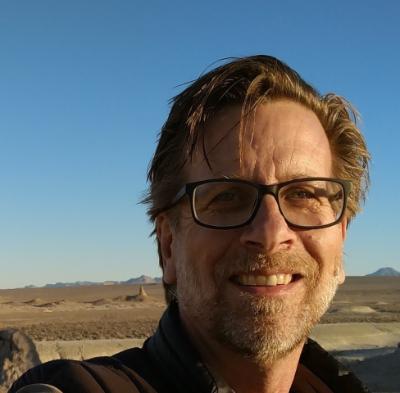
Douglas E. Christie
Media
Publications
Douglas E. Christie on Depth Without Resolution
Healed and Whole Forever, 2021
The Joy of Feeling Close to God
Wasting Time Conscientiously By Douglas E. Christie, ONEING: Unveiled
What is Contemplation?: An Interview with Douglas Christie
Biography
Douglas E. Christie, Ph.D. is Professor Emeritus of Theological Studies at Loyola Marymount University in Los Angeles. He is the author of The Word in The Desert: Scripture and the Quest for Holiness in Early Christian Monasticism (Oxford), The Blue Sapphire of the Mind: Note for a Contemplative Ecology (Oxford), and The Insurmountable Darkness of Love: Mysticism, Loss and the Common Life (Oxford). He has offered retreats to Benedictines in Oregon, and Cistercians in California, Oregon and Belgium among other places. He has been awarded fellowships from the Luce Foundation, the Lilly Foundation and the National Endowment for the Humanities. From 2013-2015 he served as Co-director of the Casa de la Mateada study abroad program in Córdoba, Argentina, a faith-based program rooted in the Jesuit vision of education for solidarity. He lives with his family in Los Angeles.
-
Begins: Fall 2026
Fees: $705
Financial aid is available for those who qualify, for more information please email CRS@lmu.edu